|
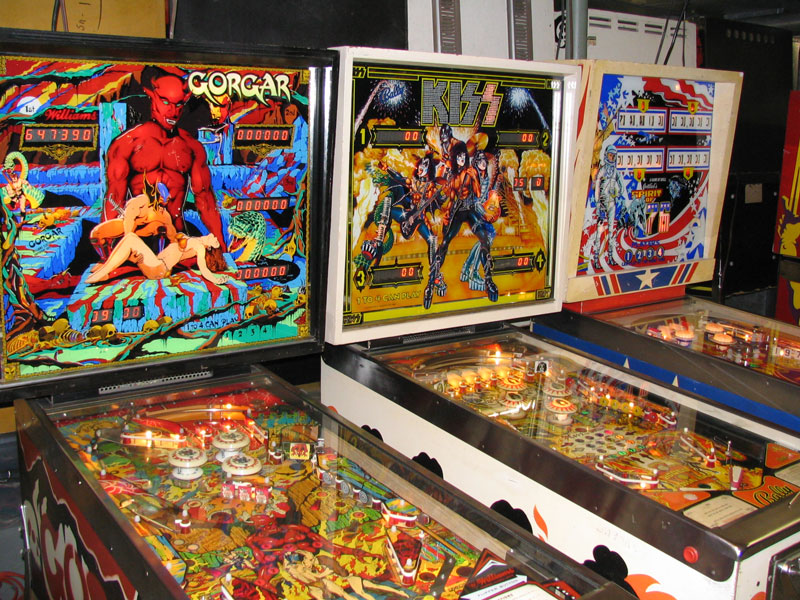
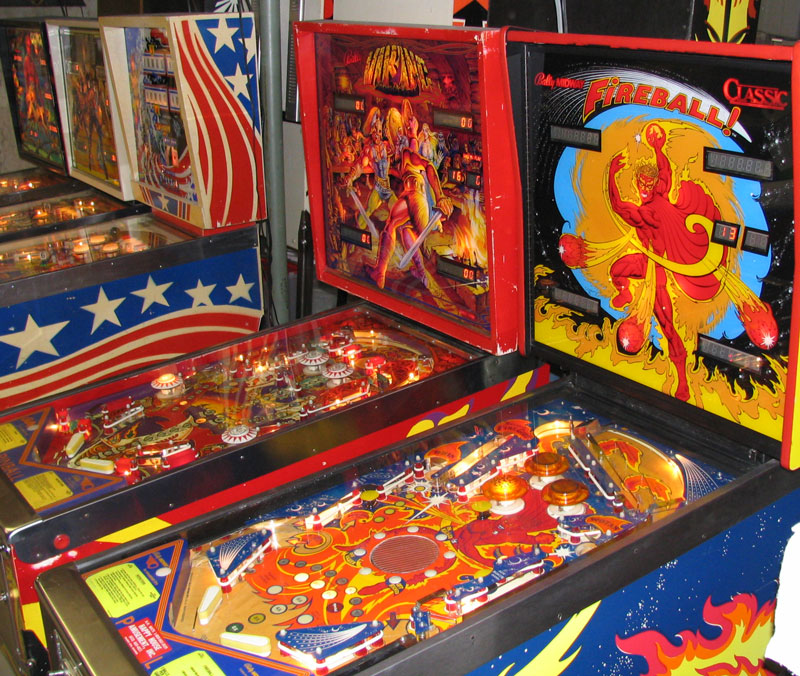
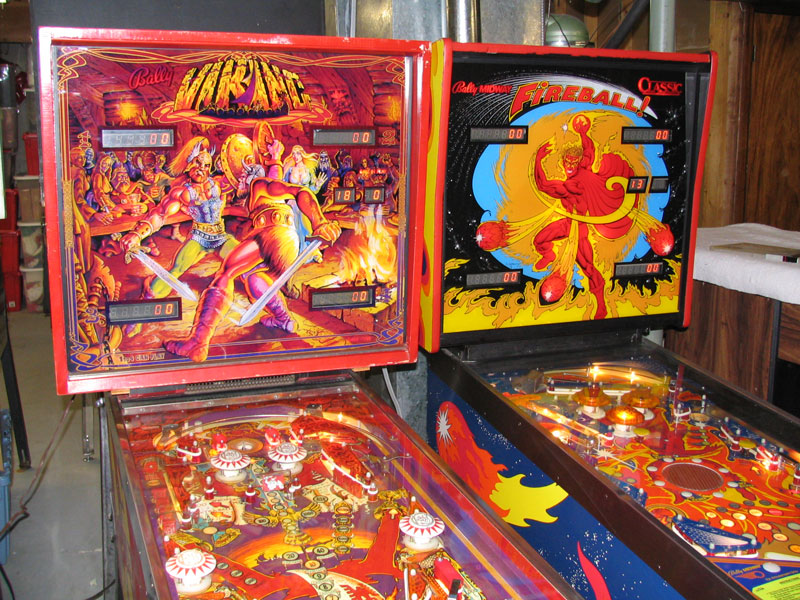
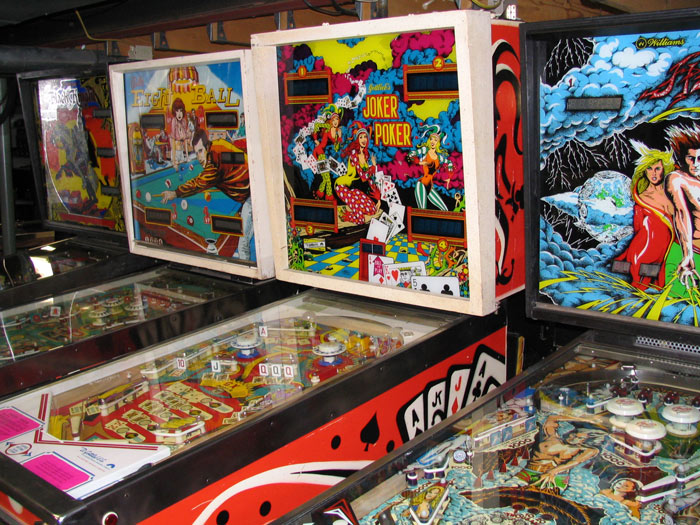
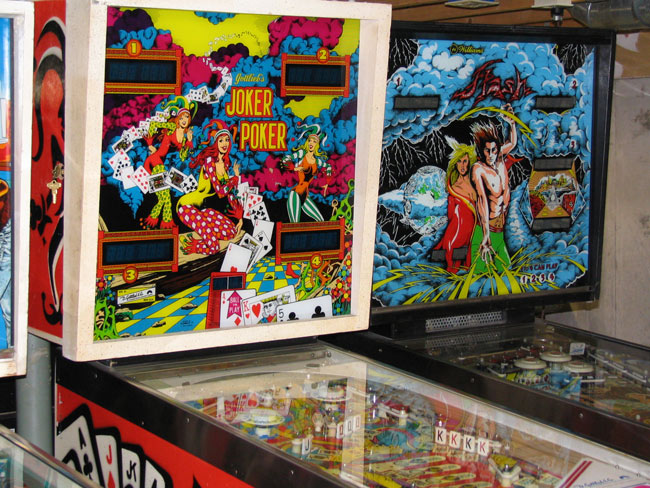
If you saw my basement, you would think I had an obsession with Pinball games. I started collecting pinball games beginning with the older electro-mechanical (EM) games back in the early 90s, then to the more modern dot matrix games (DMD), then to the solid state (SS) late 70s through mid-80s era, then back to the electro-mechanical games, and now I seem to be hovering around late 70s and early 80s games with more and more EMs coming in. At first I thought I would never leave the older EM games, but I embraced the newer stuff mostly due to the overall fun and complexity. I'd say that right now my inclination is towards EM games again along with solid state games with little to no focus on the DMDs. I really like the old games due to a sense of history that I get from playing and working on them. I have owned over 300 games, although right now my list of games in 2012 is around 74 games. I have included some pictures of the "south wall" game area in my basement so you can get an idea of my "hobby." You can use the menu items in the navigation bar at the top of each page to go directly to games and topics of interest, or you can check out the topics at the bottom of this page to see and learn more. I don't list all the games I've had because that would be too many, but the games you will find in my navigation bar have a tendency to either be in my current lineup, or a few that I no longer own but may return through a trade with local pinheads to get them back. My Pinball Links page contains many links to other collectors, sellers, traders, etc., throughout the U.S. and other countries. You can hang around here to see what I'm up to, but be sure and check out the other links as well. (click picture to enlarge)
I have many other games that aren't shown in the pictures above and I don't bother showing the 2 row lineup I have on the "north wall" since it often changes depending on whether I get a new game or not, I'm restoring a game or two or three, or if I simply want to sell or "retire" a game that I don't play anymore. The games on the backside of the main lineup (the "south wall") have a tendency to stay the same since it's a hassle to move them out of the area, but the two rows on the north side of the basement often get changed. The DMDs that I currently have (down to TZ, MM, and TOM) will probably stay in their position since they are rather heavy to move and the DMD collection has been thinned to the point that I doubt I'll get rid of these games. I also have a Joust (pinball game, not a video game) that is nearby and set up for folks that like good one-on-one action.
How I Started When I started the pinball collecting hobby most of my games were what are known as "Electro-Mechanical" games (also known as EMs). EMs use coils (solenoids) and relays and switches with the control of the game built in to a score motor loaded with stacks of switches that execute what is known as a state machine. The idea is that each game has goals to achieve that award points and a control scheme (using the score motor) that makes the game behave in a deterministic manner. Since my background is Electrical Engineering with a long history of mechanical skills, pinball games fit me perfectly. I also used to do car body repair and painting so that works well for restoring games. Add to that a complete lineup of woodworking tools and you can see that pinball hit the sweet spot for me (so to speak). Just keeping the old playfields clean, setting the switch gaps and making sure the contacts (switch contacts) are clean, etc., is the biggest problem one faces when keeping this many games running. The best cure (once the games work correctly) is to simply play them. The EM games have a tendency to need less attention if they are often played rather than leaving them sitting around unused for long periods of time. In the past, I would buy entire lots of games that came from a storage area or barn and I would find old coins in the games. Depending on where I bought an old game, I'd even find one that had been stored for a while with things other than coins found inside. They usually had a mouse nest in them consisting of insulation, dust, straw, mud, etc., from when they were stored in a barn or garage for some time and a furry friend decided to form a home. Interestingly enough, the mice didn't leave much of a mess behind them, just a little nest. So, although I began with EM games, I moved on to dot matrix display (DMD) games, and then to solid state (SS) games as part of my collecting experience. Originally, I planned to fix up some games here and there and play them, but then I became more of what I would call a collector. Now I buy games with the intent of primarily restoring games that have value to me and other collectors. This means the games are classics or aren't seen that often and have a tendency to hold their value. Well enough in fact that they can be viewed as "pinball bonds" in the sense that they are worth more money when I finish restoring them than if I had invested money in bonds in the financial market. They take up a lot more space than paper bonds, but boy they sure are more fun to handle than paper. Cleaning Can Be Fun! There are many ways to clean the old games' innards and their playfield surface, and for me, that's where most of the fun is in having the older games. When I say old, I'm meaning games from the 50s to early 80s. Games from the 80s are already at least 30 years old using a technology that is old from an electronics and programming point of view. Pinball games can be quite addicting, although when I see someone else playing them at my house, I often see that a target needs to be adjusted, a rollover switch needs to be tweaked, the tilt's off (I don't like people shaking my games around violently), or some other thing that isn't quite right. Sometimes I'm known for pulling off the playfield glass and I start dinking around with the innards. My kids and friends can get annoyed with this, so I pretty much leave them to play the game even though I'd really rather be tweaking on them. Sometimes I can't stand it any longer and off comes the glass. That isn't to say that games always need a tweaking, just that I like my games playing as they were designed to play. It's the restoration process that I enjoy the most, much more so than actually playing the games. I look at these games as though they are more than just a plaything. I look at them as a snapshot in time and enjoy bringing them back to their former glory by restoring them to a decent condition. I love watching someone else have fun playing them and appreciating how hard the games can be. Especially children old enough to know what they're doing (not the age where they just keep hitting the flippers over and over, but actually do things with a purpose). Learning To Love Electronic Games I used to love the EM games when I first started collecting, and couldn't imagine moving towards the newer games since it was the games from the 50s and 60s that I would have played at a dime store, laundromat, boardwalk, or arcade as a kid. With the advent of malls, especially in the late 70s and in to the 80s, arcades started to pop up in an area of the mall that would attract attention and quickly became the place kids would go to play games. I too played some pinball games, but not that many at a mall since the craze was more around games like Asteroids or Space Invaders which were video games. As I got older, I quit going to the arcades found in malls since not only did I not fit in with a bunch of rowdy kids, but the arcades were more focused on video games than pinball. The long and short of it is that I missed out on most of the early solid state games that began showing up in the late 70s and in to the 80s and never had much of an appreciation for pinball games from this era. I don't remember the single incident that changed things, but somehow I bought a 1992 dot matrix display (DMD) pinball game named The Addams Family back around 1996. Up until then I had been collecting and restoring EM games. I had never played this game before, and I had completely missed out on the DMD games that were popular in the 90s. Once I bought The Addams Family, I realized there was a whole new kind of pinball game that I had never played and I quickly became fascinated with not only how they worked, but also the new level of play caused by having ramps, deeper rulesets, multi-balls, and speech that added to the play of the game. As a result of The Addams Family, I realized that I needed more games from this era so I began buying many other games from the 90s. I ended up in a DMD craze that continued until around 2000 when a fellow collector, Jim Swenson, asked if I had a game that he could shop since he too enjoyed shopping older games and I had around 50 games sitting on end in part of my basement that he could pick from. That game was a 1978 Gottlieb Joker Poker which I still play once a week to this day. Once I got introduced to this one solid state game, Joker Poker, I entered a craze of buying solid state games. I cooled it a bit on the solid state games, but I've been interested in them ever since Jim brought the restored Joker Poker back to my house for me to play. I found that although I liked the newer DMD games, I liked the solid state games much more. I'm not sure why since they aren't really the same as a DMD game, but I find the games to be challenging and somewhat quaint in an odd way. The newer DMD electronic games I had acquired were great games, so don't get me wrong, but I really like the games from the 70s and 80s. The electronic games (both DMD and SS) really aren't all that hard to repair since the kinds of problems that show up are somewhat common and typically involve mechanical issues more so than electronics. When you buy a game that uses a computer chip to control it, the kinds of electronics problems you run in to are typically power transistors that control coils, or the transistors and integrated circuits that control the various game functions. I love electronics in general and ended up getting an Electrical Engineering degree, so repairing the games was never an issue. I must admit though that when it comes to electronic games, I enjoy the solid state games the most when it comes to repairs. Probably because this was the time (mid to late 70s) when I first worked as an electronic technician and electronics was my hobby. Ironically, after going from EMs to DMDs, and then to SS games, I now find myself in 2012 focused on EMs for the last few years. Due to buying a bunch of SS games over the last 12 years or so, I have a bunch to repair and restore, but I've also started buying EMs from the 50s, 60s and 70s that also need to be repaired and restored. In 2004 I found myself with primarily DMD games set up that were taking up too much room (I had the top 20+ DMD games back then), and I had to move them out of the lineup (where games are actually played, not just stored on end). This caused me to sell all but three of the DMD games I had collected throughout the 90s. I got a great return on the games since all of them sold for quite a bit more than I had originally paid for them, but now they are gone, and to get one of them back in the condition mine were in, would require me to pay quite a bit more money. Fortunately, I still have a few DMD games such as Twilight Zone, Medieval Madness, and Theatre of Magic that I have no intention of selling, so this small stock of games should hold my interest for years to come. In the meantime, I'm busy restoring SS and EM games as time permits (every week I do something with pinball restoration). I suspect that my collection will consist of a balance of EM games with some solid state games set up for play. I can only set up 22 games due to space restrictions, but I can loan games to friends and family members so that at least someone is getting to enjoy some of my games rather than having them standing on end in another part of my basement. I'm sure electronic games are here to stay as far as my collection goes, but EMs definitely have a space as well. I look at the DMD games now as more of a phase that I was once in, but my collection direction has now shifted to the games that I find more appealing - solid state and electro-mechanical games. Having said this, I doubt I will ever part with the Twilight Zone, Medieval Madness (especially this game), and Theatre of Magic (a beautiful game). I'd also entertain getting a Simpsons or Lord of the Rings which are newer Stern games, but we'll see. Want To Find Out More? Like to find out more about Pinball games? Try out my Pinball Links page if you are interested in viewing other folks' pages on Pinball, ordering parts and supplies, or just viewing what's going on in this fun hobby. I probably have one of the foremost Pinball links pages on the Internet today. I get over 700 hits per day on the Pinball links page, so others, just like me, use this page as their main Pinball links page.
You can use the navigation bar at the top of this page or use the links below:
|
|
All Graphics & Text © Steve Corley |
|
The
pictures you see were created by Steve Corley unless otherwise
noted. |